Sign up for the iWire to get breaking news, event info and the species spotlight.
Go Back | Printer Friendly Fact Sheet
 Federal Noxious Weed TDA Noxious Weed TPWD Prohibited Exotic Species Invasive Plant Atlas of the US
NOTE:
 means species is on that list.
Cyanthillium cinereum
Little ironweed
Synonym(s): Conyza cinerea L., Senecioides cinerea (L.)
Vernonia cinerea (L.) Less., Vernonia cinerea (L.)
Less. var. parviflora (Reinw.)
Family: Asteraceae
Duration and Habit: Annual Herb
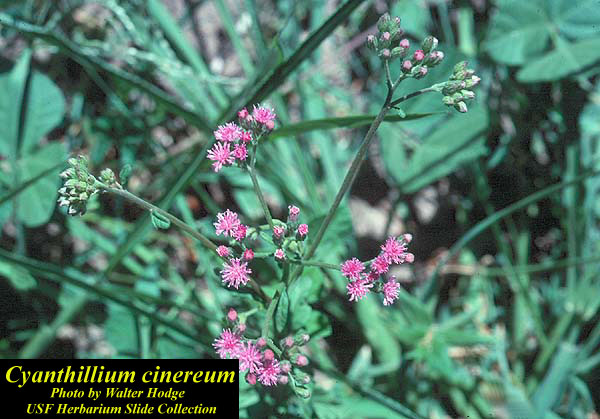
Photographer: Walter Hodge
Source: USF Herbarium Slide Collection
Description
Cyanthillium cinereum or Little Ironweed usually flowers and fruits as an herb, but can grow to be about 1 m tall and resemble a shrub. Leaves, stems, and petioles are covered with wooly hairs. Leaves are alternate, between 3-4 cm long and 1.5 - 3 cm wide. Leaves taper gradually into the petiole, which is short. The flower heads have purple to pink inflorescence; with each head containing 20-30 flowers that are approximately 5mm long.
Native Lookalikes: Currently no information available here yet, or there are no native Texas species that could be confused with Little ironweed.
Ecological Threat: It is a fast-growing, annual herb with the capacity to form dense patches in gardens, roadsides, waste grounds and pasture. It also serves as a host plant for the Cuban slug which can be invasive outside of its native range and spread namtodes such as Angiostrongylus to mammals and humans.
C. cinereum is listed as a weed in about 27 different crops in 47 countries in Asia, Australia, Africa and America. It has the potential to negatively impact natural and seminatural habitats in coastal areas, forest edges, secondary forests, upland forests, and grasslands
Additionally, it can host the tobacco leaf curl virus and the root-knot nematode.
Biology & Spread: Flowers in little ironweed are pollinated by wind. Under favorable environmental conditions it produces flowers and seeds for many months. It usually grows as a weed, thus it needs full sunlight and moderate water availability to grow. It prefers sandy-loam soils but can be found growing on a range of soils with pH ranging from 4 to 6. It can tolerate semiarid conditions and partially saline conditions
History: Studies show this species may have some medicinal uses. It could be what led to its spread outside of its native range.
U.S. Habitat: Usually found in wetlands, but occasionally found in non-wetlands. Usually found in disturbed soil. Elevation range of 100 - 2300 m.
Distribution
U.S. Nativity: Introduced to U.S
Native Origin: Africa, Asia, Australia
U.S. Present: FL, HI, USA + (PR, VI)
Distribution in Texas: Not reported in Texas
Mapping
Invaders of Texas Map: Cyanthillium cinereum
EDDMapS: Cyanthillium cinereum
USDA Plants Texas County Map: Cyanthillium cinereum
Native Alternatives
Management
USE PESTICIDES WISELY: ALWAYS READ THE ENTIRE PESTICIDE LABEL CAREFULLY, FOLLOW ALL MIXING AND APPLICATION INSTRUCTIONS AND WEAR ALL RECOMMENDED PERSONAL PROTECTIVE GEAR AND CLOTHING. CONTACT YOUR STATE DEPARTMENT OF AGRICULTURE FOR ANY ADDITIONAL PESTICIDE USE REQUIREMENTS, RESTRICTIONS OR RECOMMENDATIONS. MENTION OF PESTICIDE PRODUCTS ON THIS WEB SITE DOES NOT CONSTITUTE ENDORSEMENT OF ANY MATERIAL.Text References
Holm L, Doll J, Holm E, Pancho J, Herberger J, 1997. World Weeds. Natural Histories and Distribution. New York, USA: John Wiley and Sons, Inc.
Pruski JF, 2013. Asteraceae. In: Flora Mesoamericana, Volume 5 (2) [ed. by Davidse, G. \Sousa Sanchez, M. \Knapp, S. \Chiang Cabrera, F.]., Mexico: Universidad Nacional Autonoma de Mexico. http://www.tropicos.org/docs/meso/asteraceae.pdf
Online Resources
USDA-NRCS (2013). Plants Database: Cyanthillium cinereum. http://plants.usda.gov/java/profile?symbol=CYCI4
USDA, ARS, National Genetic Resources Program. Germplasm Resources Information Network - (GRIN) [Online Database]. (May 2013). http://www.ars-grin.gov/cgi-bin/npgs/html/taxon.pl?406954
https://www.cabidigitallibrary.org/doi/10.1079/cabicompendium.113702
Australian Tropical Rainforest Plants: Factsheet. http://keys.trin.org.au/key-server/data/0e0f0504-0103-430d-8004-060d07080d04/media/Html/taxon/Cyanthillium_cinereum.htm
Encyclopedia of Life. http://eol.org/pages/595253/overview
Search Online
Google Search: Cyanthillium cinereum
Google Images: Cyanthillium cinereum
NatureServe Explorer: Cyanthillium cinereum
USDA Plants: Cyanthillium cinereum
Invasive Plant Atlas of the United States: Cyanthillium cinereum
Bugwood Network Images: Cyanthillium cinereum