Bill Carr,
Bill Carr
Family: Boraginaceae
Synonym(s): Cynoglossum pictum
Duration: Biennial
Habit: Forb/Herb
Listed by:
Invasive Plant Atlas of the US: 0
Federal Noxious Weed: 0
TDA Noxious Weed: 0
TPWD Prohibited Exotic Species: 0
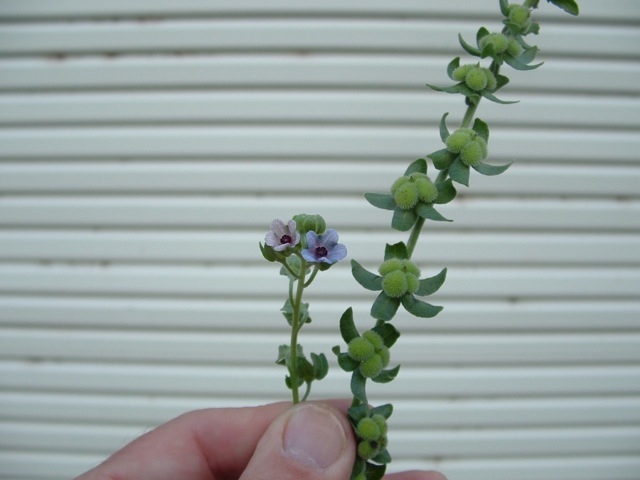
Description: Basal rosettes occur during early stages of growth. Stems are covered in fine hairs and can reach a height of 60 cm (24 in). The dark green leaves are oblong, can reach a length of 200 mm (8 in) and a width of 25-30 mm (1-1.2 in). The leaves are covered in hairs and are alternately arranged with short petioles. They have entire (untoothed) margins. The flowers are small (7-11mm or 0.3-0.4 in), consisting of five petals and range from blue to pink with dark veins. The flowers are arranged on one side of a stem, which is coiled but elongates as the flowers open. Fruits are mericarps that occur in groups of four, and each contains one seed. These mericarps turn green to brown upon maturity with each mericarp covered in fine barbed prickles.
History: First known U.S. specimens found in Missouri Botanical Garden herbarium collection in 1989 and then 2006. Found in Burnet County, TX, southwest of Oakalla on May 30th, 2015.
Biology & Spread: Mericarp dispersal is the main method of reproduction. The barbed mericarps can attached to fur or clothing and can be transported by animals.
Ecological Threat: Potential to outcompete and suppress native grasses. Leaves contain pyrrolizidine alkaloids which is toxic to livestock. Livestock will avoid in pasture but may consume the plant if it is mixed in with fodder. Has become a problem in pastures in some parts of the world. Currently on Australia's Alert List for Environmental Weeds (28 introduced plants that are currently not very widespread but are considered to pose a threat to Australia's environment. [keyserver.lucidcentral.org]).
US Habitat: Warm temperate grasslands and disturbed areas such as roadsides.
Distribution
US Nativity: Exotic
Native Origin: Mediterranean Basin including: France, Spain, Portugal, Italy, Albania, Greece and Bulgaria
US States: MO, TX
Resembles/Alternatives: Cynoglossum virginianum - Wild Comfrey. The arrangement of the flowers of C. creticum along one side of the stem is diagnostic: C. virginianum flowers are not arranged on one side of the stem.
Management: Prevention and early response to local infestations are key. Inspect hiking gear, livestock, and pets before leaving a known infestation. Also see http://www.weedscrc.org.au/documents/wmg_blue_hounds_tongue.pdf
USE PESTICIDES WISELY: ALWAYS READ THE ENTIRE PESTICIDE LABEL CAREFULLY, FOLLOW ALL MIXING AND APPLICATION INSTRUCTIONS AND WEAR ALL RECOMMENDED PERSONAL PROTECTIVE GEAR AND CLOTHING. CONTACT YOUR STATE DEPARTMENT OF AGRICULTURE FOR ANY ADDITIONAL PESTICIDE USE REQUIREMENTS, RESTRICTIONS OR RECOMMENDATIONS. MENTION OF PESTICIDE PRODUCTS ON THIS WEB SITE DOES NOT CONSTITUTE ENDORSEMENT OF ANY MATERIAL.
Listing Source
Texas Department ofAgriculture Noxious Plant List
Texas Parks and Wildlife Department Prohibited Exotic Species
Invaders Program
Federal Noxious Weed
Union of Concerned Scientists
United States Forest Service Southern Research Station
Text References
http://www.environment.gov.au/biodiversity/invasive/weeds/publications/guidelines/alert/pubs/c-creticum.pdf
http://keyserver.lucidcentral.org/weeds/data/03030800-0b07-490a-8d04-0605030c0f01/media/Html/Cynoglossum_creticum.htm
uswildflowers.com/detail.php?SName=Cynoglossum%20virginianum
http://www.weedscrc.org.au/documents/wmg_blue_hounds_tongue.pdf
Data Source
Observations of Texas population by WFC and other knowledgeable personnel. Voucher specimen collected by WFC.
Last Updated: 2015-06-10 by LeBlanc